Learning to Love a Landscape: Forest Bound 2026
By Tanner Johnson, August 2026
In the world of conservation, it can often feel like we are up against forces that are too big to overcome. While the mighty Rio Grande River has run dry in Albuquerque and the relentless onslaught of wildfire only seems to get worse each year, it can be easy to get lost in the doom and gloom of it all.
This is one of the many reasons I feel lucky to have an annual reminder of the joy and curiosity inherent in all humans, especially young humans, when they feel a true connection to their landscape. In my position as Education and Outreach Coordinator, I get to share the joy of connecting with the land and its more-than-human inhabitants with young people each year through our Forest Bound program, and in 2026, the program grew by leaps and bounds.
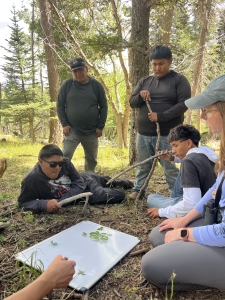
In 2026, IAE was able to offer four sessions of Forest Bound, with a record-breaking attendance of more than 50 students. Two of those sessions were brand-new partnerships with Pueblo communities: a first-ever Spring Break session with Nambé Pueblo and a summer session with San Felipe Pueblo. We were also able to continue and expand our partnership with the Pueblo of Pojoaque’s Téwa Language Department, as well as offer a public session in the Santa Fe and Cibola National Forests.
In the spring, we conducted a three-day session of Forest Bound with Nambé Pueblo’s Téwa Roots Society, exploring the diverse ecosystems on Pueblo lands while learning Téwa language from members of the Téwa Language Department at the Pueblo of Pojoaque. In addition to exploring Nambé Pueblo, we visited Bandelier National Monument, home to an extensive Ancestral Puebloan village site and diverse flora. Students engaged in restoration practices by creating seed balls with native wildflower seeds to support pollinators in their community.
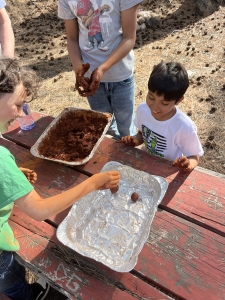
The three summer sessions shared common lessons and themes, but were each distinct in their focus. Our first session was the open-enrollment session available to any teens who wanted to sign up. Over the five days of the session, we focused heavily on native plant identification and ecology. Students visited sites in the Sandia and Jémez Mountains, learning common plant family traits and adaptations. They also had the opportunity to visit the Santa Ana Native Plants nursery to hear from professionals who have made their love of native plants into a career, helping to propagate and expand the number of native plants on the landscape.
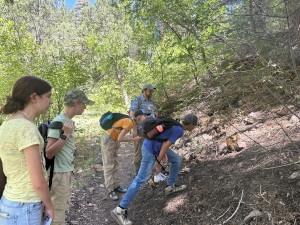
The Téwa Language session was a collaborative effort with the Pueblo of Pojoaque’s Téwa Language Department and Nambé Pueblo’s Téwa Roots Society. As in previous years, this session took a Two-Eyed Seeing approach, presenting Western science alongside Indigenous language and worldview learning. Students learned about and worked with medicinal native plants, learned Téwa names for native plants, participated in stewardship by constructing one-rock dams, and explored the complex relationships between ecosystems and wildfire.
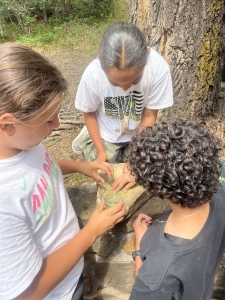
At San Felipe Pueblo, we worked with youth interns from their Department of Natural Resources. These intrepid young adults dove headfirst into what is a new program for their community. We focused heavily on developing job skills for working with the natural world, doing hands-on restoration at sites around the Pueblo, and learning about invasive species management.
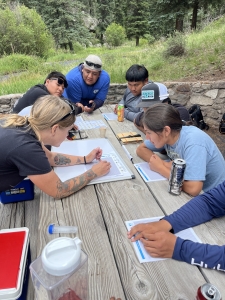
The through line for each of the Forest Bound sessions this year was participation in the Xerces Society’s New Mexico Bumblebee Atlas. This community science program, now in its first year, was a highlight for every session, providing a tangible example of the inextricable link between plants and animals. In my decade of teaching about ecosystems to youth, students’ participation in this real, cutting-edge field science curriculum has proved to be one of the most engaging educational programs I have ever seen. Students who were once afraid of bees ended the day by high-fiving a bumblebee, and you could see the connection they were developing to the land.
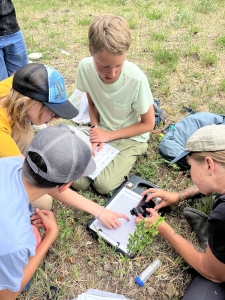
For me, these moments are a reminder that conservation is not only about protecting landscapes, restoring habitat, or collecting data. It is also about building relationships. It is about giving people the opportunity to spend enough time in a place that they begin to notice the plants growing around them, the insects moving through those plants, and the larger web of relationships that connects them all. That kind of connection can be difficult to quantify, but it is one of the most important things we can cultivate.
The problems facing our ecosystems are enormous, and I don’t think young people need us to pretend otherwise. What we can give them is something more useful than false optimism: the knowledge that they belong to these landscapes, the skills to care for them, and the experience of seeing that their actions can make a difference. Watching a student who was once nervous around bees become excited enough to high-five a bumblebee may seem like a small thing in the face of climate change, wildfire, and all the other forces reshaping our world. But conservation is ultimately made up of small acts of attention, care, and connection repeated over time.
Forest Bound gives me the chance to witness that process every year. And in a field where it can be easy to lose sight of what we are working toward, I am grateful for the reminder that the work is not only about preventing what we stand to lose: it is also about helping people discover what is worth loving in the first place.
We thank the US Forest Service, Environmental Education New Mexico, and the New Mexico Outdoor Recreation Department’s Outdoor Equity Fund for their generous funding support.