Restoration under solar arrays: powering the grid and pollinators
by Katy Silber, July 2026
In a rapidly changing world, the best solutions are the ones that solve multiple problems at once. In New Mexico, solar arrays turn our abundant Southwest sunshine into a thriving renewable energy source. Over 12,000 acres of the state are now covered in solar arrays, powering millions of homes and businesses.
But as we look to the sky for clean energy, we also need to look at what’s happening on the ground. While some solar panels can be installed with minimal disturbance to native ecosystems, others require heavy grading and clearing. But what if these thousands of acres could be dual-use, providing both clean energy and vital habitat for local wildlife?
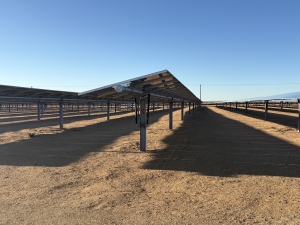
Solar arrays do more than generate electricity – they actively change the environment beneath them. In the powerful Southwest heat, the arrays catch moisture and provide much-needed shade. This creates microclimates to help plants establish and survive, which in turn provides food and shelter for pollinators, birds, mammals, and other wildlife.
We are in the early days of understanding exactly how solar arrays can support wildlife in the Southwest. To bridge this gap, IAE Ecologists teamed up with Affordable Solar, a solar company based in Albuquerque New Mexico, to restore habitat for native pollinators while also honing in on the most effective ways to do this.
Over the past year, we developed a specialized, pollinator-friendly native seed mix and installed it across the site using various seeding and mulching rates and site preparation methods. These seeding trials will provide insights into the most resource-efficient ways to create and restore habitat for these common and at-risk insects.
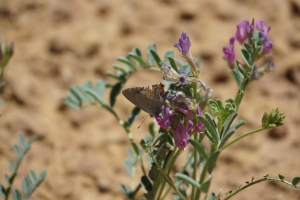
But this isn’t just a win for the bees and butterflies – it’s a massive win for solar companies too. Bare ground means dust, stormwater runoff, and erosion – all of which increase maintenance costs and creates challenges for regulatory compliance. Planting deep-rooted native species naturally stabilizes the soil, controls dust, and has the potential to slash long-term maintenance costs.
While this initial project restored 35 acres, our vision is much bigger. We hope to continue refining our approach, learning best practices, and scaling this model up statewide.
By rethinking how we manage the land beneath our green energy infrastructure, we can protect the planet from the top down and the ground up.
We thank Affordable Solar for funding the restoration, seeding trials, and vegetation monitoring, and the Carroll Petrie Foundation for providing financial support for pollinator monitoring.
Questions? Interested in collaborating on a solar project? Email Katy Silber at katysilber@appliedeco.org.