The Skipper and the Gorge
By Emily Rees, August 2026
IAE Southwest staff have now completed two trips this summer tracking a rare butterfly in the Rio Grande Gorge north of Taos, NM. The small riparian skipper, only slightly larger than a quarter, has an incredible life history. The Questa Skipper, Ochlodes yuma anasazi, is only found on a 15-mile stretch of the Rio Grande and utilizes habitat both within the gorge and on the plateau above, separated by a 700-foot cliff wall. How does this tiny butterfly navigate the gorge wall, and why does it make the journey? These questions remain a mystery.
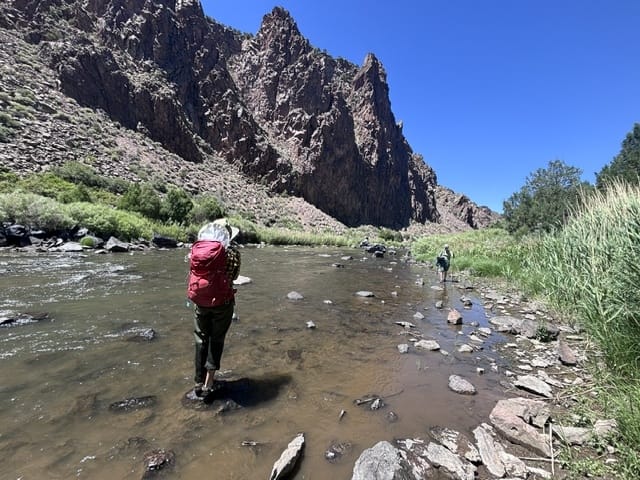
The Questa Skipper, Ochlodes yuma anasazi, is one of the rarest butterflies in New Mexico due to its narrow habitat range within a stretch of the Rio Grande where the river carves a deep gorge into the Taos Plateau. This stretch of the river, sitting at approximately 6,600 feet above sea level, is classified as a wild river area under the federal Wild and Scenic Rivers Act and lies within the Rio Grande del Norte National Monument, managed by the U.S. Bureau of Land Management’s Taos Field Office.
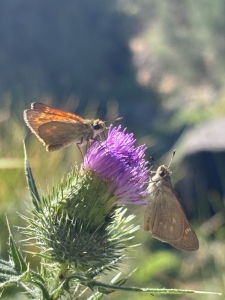
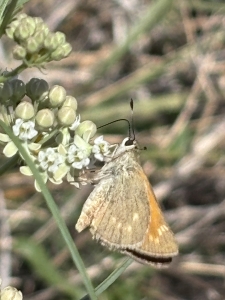
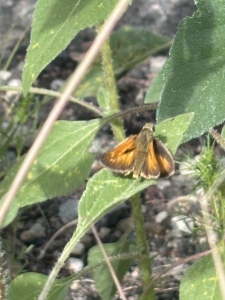
The subspecies was first described by Steve Cary in 1995. Since then, Steve has made countless trips to the gorge and documented observations that account for much of what we know about this tiny butterfly.
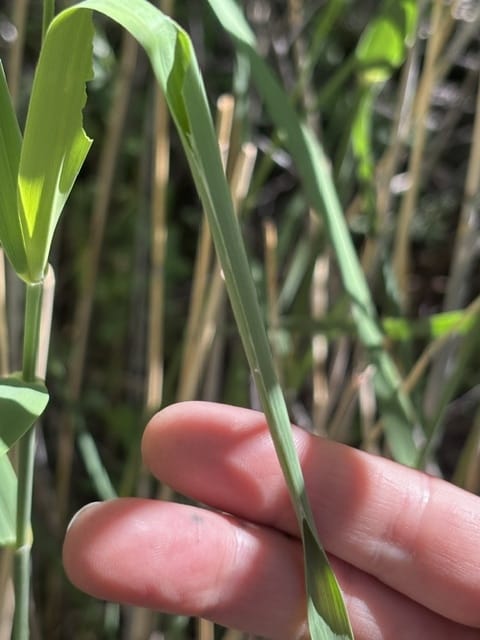
This year, IAE set out to build on Steve’s work by measuring and documenting the habitat resources that support the Questa Skipper. Our first trip, conducted in June, focused on habitat within the gorge. The Questa Skipper relies on patches of Phragmites australis subsp. americanus along the river as its sole host plant. Caterpillars roll the leaves around their bodies, creating a distinctive fold that makes them easier to identify.
Over four days, IAE ecologists hiked in and out of the gorge at multiple access points, conducting detailed surveys across five miles of the river edge. Our primary focus was identifying and mapping Phragmites reed patches and measuring their size, density, and potential threats, including non-native plant encroachment. We also timed the trip in hopes of documenting larval occurrences within the reed patches.
Fortunately, the timing was on our side. Once we saw how prolific the caterpillars were within the reed patches, we quickly modified our methods. To reduce our potential impact on the habitat, we switched from entering the patches to counting evidence of larvae from their perimeter. In total, we mapped 18 reed patches and documented 669 caterpillar larvae.
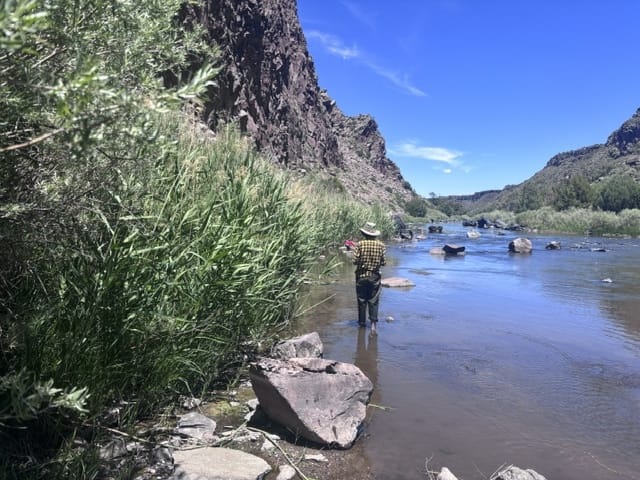
Our second trip, conducted in August, focused on documenting adult resources both at the bottom of the gorge and on the plateau, as well as observing adult butterflies. During this portion of the work, IAE staff were honored to be joined by Steve Cary, who helped confirm identifications and shared insights he has gathered over the years about this rare butterfly.
Male and female adults were observed on the plateau nectaring on known resources such as Asclepias subverticillata and Ericameria nauseosa, along with newly documented nectar resources including Helianthus annuus and Verbena macdougalii. Down in the gorge, nectar resources largely consisted of Ericameria nauseosa, Brickellia leptophylla, and Cirsium spp. Observations of adult butterflies within the gorge occurred only near reed patches associated with seeps and along the river’s edge.
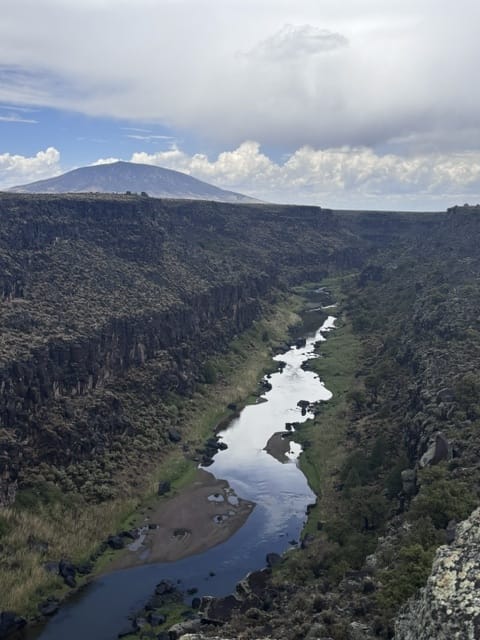
Seeing both male and female adults up on the plateau and down in the gorge left us with many lingering questions. If nectar resources are available within the gorge, why do some butterflies travel to the plateau to feed? No mating individuals were observed during the late-summer trip, raising another question: where does mating occur? Is it in the gorge or on the plateau?
And perhaps most intriguingly, how often are individual butterflies making the journey across the gorge wall? For a butterfly this small, anything more than an up-and-back flight seems like a significant undertaking. Are all individuals making the journey to the plateau, or only adults from certain reed patches connected to seeps, where the distance to the plateau may be shorter?
These questions are part of what makes studying the Questa Skipper so fascinating. Every field season gives us a little more information about the habitat this butterfly depends on, while also revealing new pieces of its life history that we don’t yet understand. By continuing to document its host plants, nectar resources, and habitat across the gorge and plateau, we can begin to build a clearer picture of what this rare butterfly needs to persist in the landscape.
This work is funded by the Carroll Petrie Foundation and conducted in collaboration with the BLM Taos Field Office.