On the Edge of the Prairie: Creating Safe Nesting Habitat for the Streaked Horned Lark
by Laura Estrada (she/they), Conservation Research Ecologist, January 2026
The Streaked Horned Lark (Eremophila alpestris strigata) is an endangered prairie bird that occupies one of the most challenging habitats for restoration ecologists to manage.
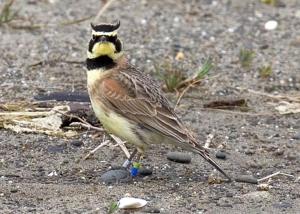
This species is highly dependent on disturbance, requiring landscapes with sparse vegetation and exposed soil for successful breeding.
Today, many Streaked Horned Larks occupy areas such as Christmas tree farms and airports, where intensive management creates vegetation structure that initially appears suitable. However, these same practices often compromise nests and reduce breeding success.
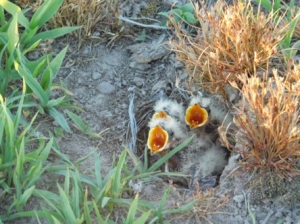
As conservationists, it is our responsibility to encourage these birds away from high-risk working landscapes and toward protected lands where reproduction can occur more successfully. Herbert Farm and Natural Area is one such refuge for the Streaked Horned Lark population associated with the Corvallis Municipal Airport.
Over the past decade, substantial efforts have been made to encourage Streaked Horned Larks to use Herbert Farm, while also managing habitat for numerous other threatened and endangered species within the already-limited Willamette Valley prairie ecosystem. These efforts have been driven by a broad coalition within the conservation community.
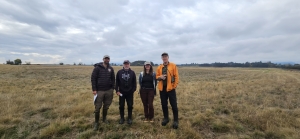
In 2012, the City of Corvallis acquired what is now Herbert Farm. Following the acquisition, many former agricultural fields were placed into chemical fallow to prepare the site for prairie restoration. Shortly thereafter, a notable influx of Streaked Horned Larks was observed. To further improve habitat conditions, the U.S. Fish and Wildlife Service installed habitat berms—also known as swales—in 2016. These swales proved successful for Streaked Horned Larks, but beyond them, a new challenge emerged.
Extensive prairie restoration outside the swales resulted in stunning upland prairie habitat. Unfortunately, this success also meant that vegetation structure became too dense for Streaked Horned Larks. Combined with slow revegetation within the swales themselves, Herbert Farm currently supports no breeding pairs. Today, managers are grappling with how to balance the habitat needs of Streaked Horned Larks while maintaining high-quality prairie for many other species.
With funding from the Oregon Conservation and Recreation Fund and the support of Oregon Department of Fish and Wildlife, City of Corvallis Parks and Recreation, and Avifauna Northwest, the Institute for Applied Ecology (IAE) has taken on this challenge by creating targeted nesting habitat patches that build upon the existing swale infrastructure. While swales can attract Streaked Horned Larks, their suitability varies year to year depending on spring rainfall. If swales remain flooded into April, they become unusable during a critical breeding window. To address this, IAE established habitat patches along swale edges, creating drier zones that remain accessible as water slowly recedes.
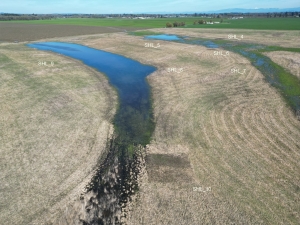
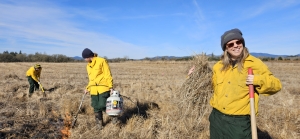
To date, IAE has created twelve habitat patches using herbicide applications and flame weeding to reduce vegetation and expose bare soil. In tandem with this work, IAE has been actively monitoring Streaked Horned Lark use at Herbert Farm. While no birds have yet returned, the lessons learned from this project will inform future management decisions and adaptive strategies as we continue working to conserve this remarkable and resilient prairie bird.