By Ari Pepper, May 2026
The Institute for Applied Ecology has partnered with New Mexico’s Energy, Minerals and Natural Resources Department’s Botany and Endangered Plants Program (EMNRD), and the Native Plant Society of NM to kick-off a new and exciting statewide community science program called Rare Plant Watch. The program’s volunteers are venturing out into deserts and mountains across New Mexico’s vast landscapes to revisit historical occurrences of rare and sensitive plant species.
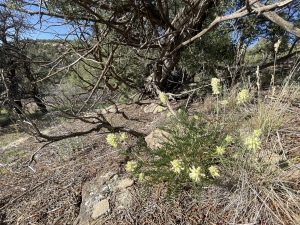 New Mexico is the fourth most biodiverse state in the country, and this is reflected by the diversity of rare plant species found here. Over 240 species are currently on the New Mexico Rare and Endangered Plant list, several of which grow nowhere else in the world. Many of our historical records for these species date back to the 1950’s, 60’s and 70’s, when botanists documented populations and species for early floristic surveys and herbarium collection efforts. While these observations remain incredibly important today, many of the sites have not been revisited since they were first recorded. With scores of species of rare plants at hundreds of sites and few botanists within the state, land managers don’t have the capacity to visit every population (or even a substantial fraction of them) every year.
Over time, landscapes change. Wildfire, drought, invasive species, land-use and shifting climate conditions can all influence whether rare plant populations can persist in the places where they were originally documented. In many cases we simply don’t know if the species are still present, and that’s where Rare Plant Watch comes in.
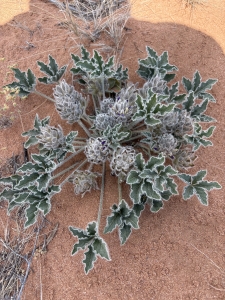
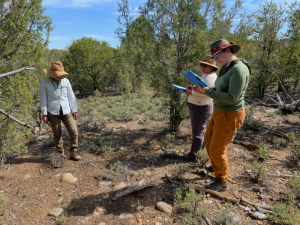 The program works to bridge the information gap by revisiting these old records. Volunteers are trained in navigating to sites, identifying target species, assessing habitat conditions, and using a standardized survey method to document what they find. So far, over 95 individuals have signed up to participate, and surveys for early flowering species have already been submitted. One species volunteers have already helped document is Pediomelum pentaphyllum, or Chihuahua scurfpea, a unique native legume adapted to the arid landscapes and sandy soils of the American Southwest. With a large taproot, the species is well suited to respond to periods of drought. In some years, it may go dormant and never appear on the surface, making it especially difficult to monitor. When conditions are suitable, hundreds of plants may emerge suddenly in either the spring or the late summer. The photos and survey information submitted by volunteers help to improve our understanding of where these species still occur and what kinds of habitats they rely on.
Every survey conducted by volunteers contributes valuable information, even if the target species isn’t found. Knowing whether a population still exists or not can help land managers and conservation practitioners better understand long-term ecological changes and makes certain that management decisions are made with the best, most accurate information available.
 One of the most rewarding parts of the program has been seeing people connect with New Mexico’s incredible plant diversity. Volunteers are not only contributing meaningful, scientific data, they are also exploring landscapes many people might otherwise overlook while delving into the state’s botanical heritage. At its heart, this is what Rare Plant Watch is all about. Somewhere out on the edge of a mesa, tucked into a canyon wall, or blooming quietly on an ignored desert hillside, may be a rare plant population that hasn’t been seen by anyone in over 50 years. By bringing together community members, scientists and conservation professionals, the program is helping to build a better understanding of New Mexico’s rare flora and ensuring these species remain a part of the state’s ecosystems for future generations.
If you’re interested in signing up it’s not too late! Email the volunteer coordinator at rareplantwatch@appliedeco.org or visit the Rare Plant Watch website to get all the information you need to get outside and get exploring!
Acknowledgements: This program would not be possible without generous funding provided by the Native Plant Society of New Mexico in 2026 as part of its 50th anniversary initiatives. IAE is grateful to EMNRD’s Endangered Plant Program staff, including State Botanist Erika Rowe and Botanist/Ecologist Katie Kline, for initiating the development of the Rare Plant Watch Program, recruiting volunteers, launching the website, securing funding with the Native Plant Society, and including IAE in this tremendous effort.

About
Restoration
Research
Education
Get Involved
Contact
Main Office:
4950 SW Hout Street
Corvallis, OR 97333-9598
541-753-3099
info@appliedeco.org
Southwest Office:
1202 Parkway Dr. Suite B
Santa Fe, NM 87507
(505) 490-4910
swprogram@appliedeco.org