By Anna Freitas, Kait Wright, and Zade Clark-Henry
August 2020
It was our first day in the field as members of Institute for Applied Ecology’s Prairie and Oak Inventory crew, and we were admittedly disappointed not to see either of our namesakes. After several hours of walking in the rain through Douglas-fir forest and dripping vine maples, finding no oaks and few of the herbaceous species that accompany them, it was time to head back to the trucks. We had surveyed five sites that our partners at the Bureau of Land Management (BLM) had indicated might contain prairie or oak, two plant communities that have been diminished to a fraction of their original extent in the Willamette Valley of Oregon. On our way back to the vehicles, soggy from pushing through rain soaked oceanspray, we heard our crew lead, Julia Fields, call out in surprise, “Oh! An oak!” It was crowded by shrubs, spindly from suppression, but given the thick forest and shrubs we had been walking in all day, it was the last thing we expected to find. We mapped its location and left the field for the day feeling excited and ready to find more hidden surprises during the season!
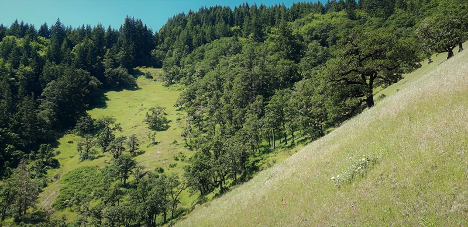
Fortunately, we got to see many more oaks that were not so lonely and suppressed in the 57 sites we surveyed in May and June. We worked at sites across the BLM’s Northwest Oregon District, from east of Springfield to west of Dallas, from Yamhill down to Lorane. While some sites had little to no evidence of being prairie or oak habitat, we would often be suddenly dazzled by sunlight and rewarded with discovering open prairies after wading through sword fern, oceanspray, poison oak and blackberries. Some had hundreds of oaks, occasionally reaching over 50 feet tall with sturdy trunks and sprawling branches. They provided glimpses of expansive prairies that historically spanned into the forest and across other nearby clearings. A few of these gems of prairie and oak habitat were alongside new and old logging roads winding through the forest. Others felt like they had been out of human sight for many years, isolated by steep slopes and treacherous terrain. Even the highest quality and most isolated sites, however, were usually dominated by non-native invasive species like hairy dogstail grass, ripgut brome, oxeye-daisy, and Scotch broom. At the same time, these beautiful but invaded prairies embody hope for maintaining and even expanding one of North America’s rarest ecosystems through the restoration efforts of organizations like the Institute for Applied Ecology (IAE) and BLM.