Restoring Pioneer Butte, one stick at a time
September 2018
Wow, what a day and what a great volunteer crew we had to help with the Institute for Applied Ecology’s (IAE) Pioneer Butte restoration project! First and foremost, thank you to all of the Oregon State University students that volunteered for IAE’s Pioneer Butte project with the Center for Civic Engagement’s Fall into Service Day. You all rocked!
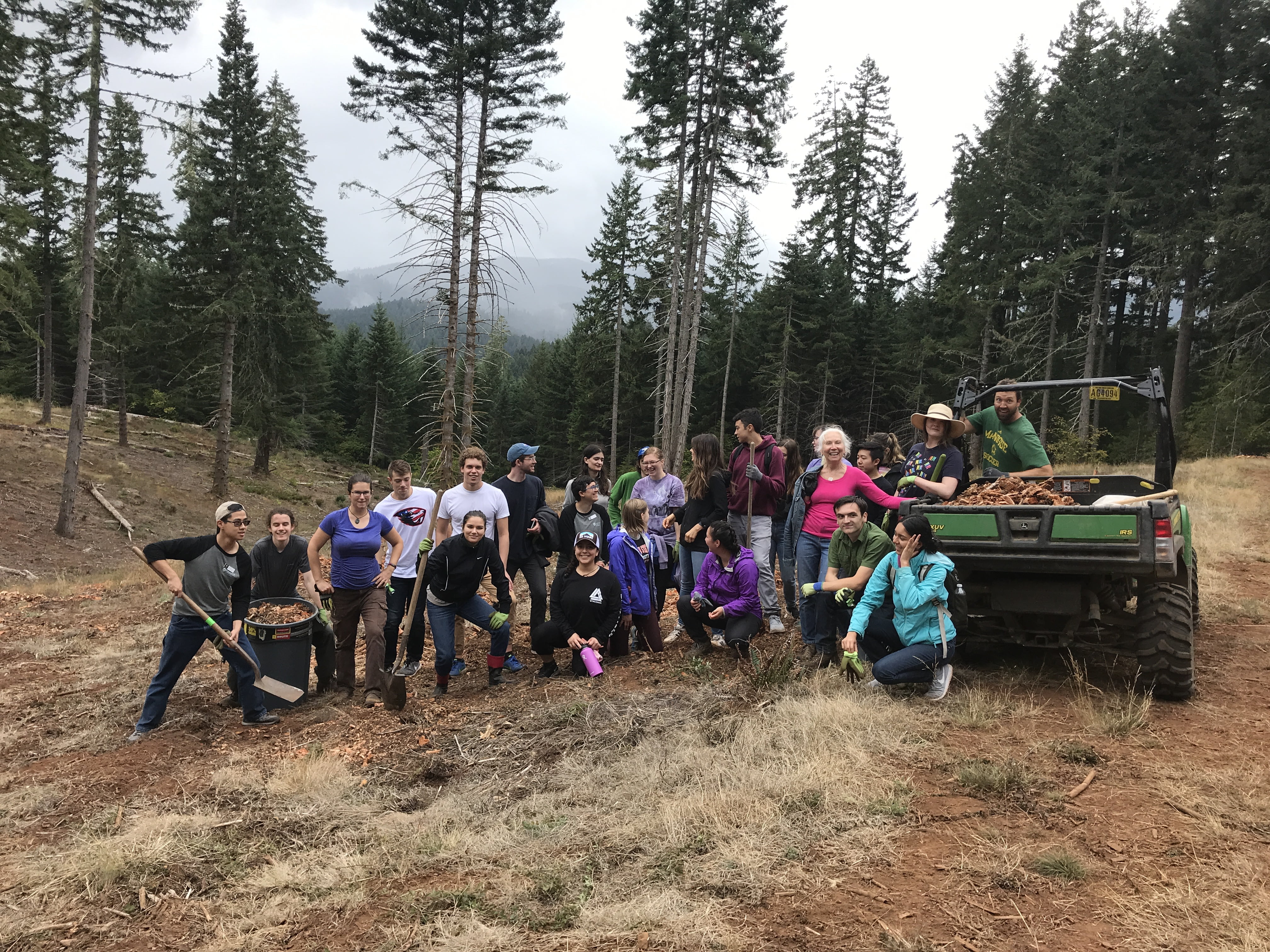
The day started at 9 am a bit ominously, with chilly drizzle and dark gray clouds in the sky. That did not seem to bother the OSU students who had signed up for this event, as I was greeted with big smiles and positive attitudes. I introduced myself to the group of seven volunteers, and we loaded up in their van and headed to Pioneer Butte. Upon unlocking a Forest Service gate for the site, to my surprise three more white vans appeared filled with cheerful, energetic volunteers. Now a group of 27, we were ready to roll!
Pioneer Butte is a mid-elevation prairie owned and managed by the U.S. Forest Service, and is located in the Oregon Coast Range approximately four miles northeast of Marys Peak. Oak prairies provide unique habitat for wildlife and pollinators, and are one of the most threatened ecosystems in the Pacific Northwest. Tree encroachment due to wildfire suppression, especially from conifers, are a threat to remaining prairie ecosystems. Historic photographs from 1948 suggest that Pioneer Butte historically was a large prairie, possibly maintained by homesteaders. Due to decades of conifer encroachment, Pioneer Butte has been reduced to two remnant prairies that were collectively less than one acre in 2015. In 2015, the Forest Service began restoration efforts to increase the size of the prairie by cutting down 13-acres of trees. At the same time, IAE joined the project to help turn the encroaching forest back into a meadow, which is no small feat. Part of the process to restore Pioneer Butte is to plant native species. Many of the species we anticipate planting are adapted to fire and need some sort of disturbance every few years. Unfortunately, burning is not permitted, so the next best thing is mowing. Mowing, however, will be quite difficult since there are large pieces of wood and stumps throughout the site that were left behind when the trees were cut. To fix this problem, IAE, the Forest Service and wonderful volunteers have begun removing all the debris, one stick at a time.

Each stick removed will allow mowing to maintain this prairie

Taking woody debris off this site

An ATV makes work easier

OSU’s Center for Civic Engagement’s Fall into Service Day volunteers
My favorite part of the event was at the end when everyone gathered around the vans and participated in an activity I’d never heard of, called Rose-Thorn-Bud. Each person got an opportunity to explain what their favorite part of the event was (rose), their least favorite part (thorn), and something they learned or might change in the future (bud). The positive sentiments towards learning about ecology and restoration, being out in nature and taking a moment to disconnect from life (you know, phones, email, news, and all that good stuff) was so refreshing to hear. It was a nice reminder that the work we do at IAE goes far beyond restoring landscapes and educating people, but it can bring people from different backgrounds and interests together and create a positive space for all to enjoy. Thanks again everyone for a great day, and see you at Marys Peak on October 22.


Restoration
Research
Education
Contact
Main Office:
4950 SW Hout Street
Corvallis, OR 97333-9598
541-753-3099
info@appliedeco.org
Southwest Office:
1202 Parkway Dr. Suite B
Santa Fe, NM 87507
(505) 490-4910
swprogram@appliedeco.org


© 2026 Institute for Applied Ecology | Privacy Policy