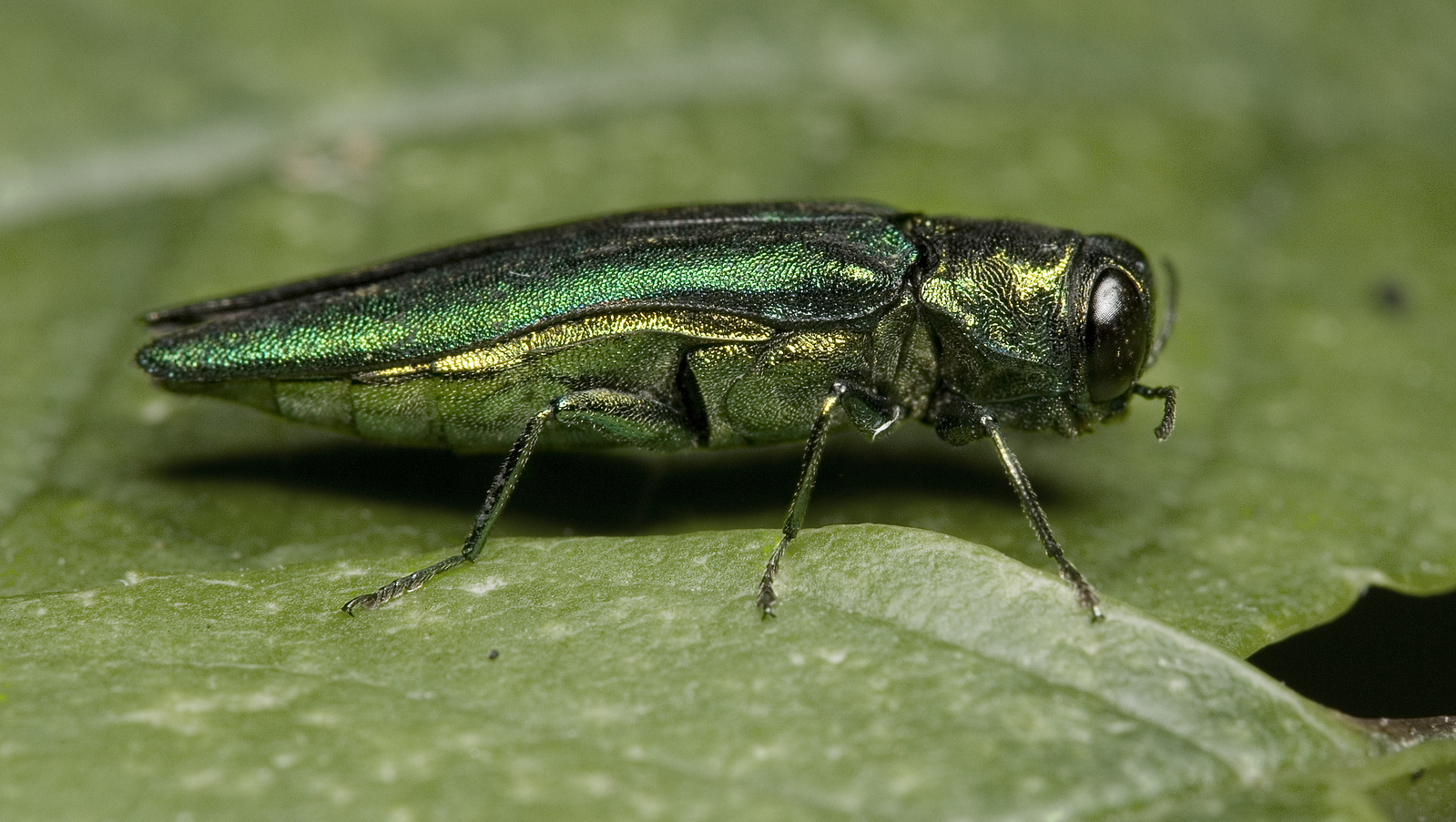
Emerald Ash Borer Invades Oregon — What to expect
September 1, 2022
In 2002, entomologists (I was one of them) in Michigan were presented with a striking iridescent beetle that had emerged from a stack of ash firewood. We knew that it was a buprestid — a jewel beetle. Not a surprise; these beetles are wood borers, generally found in stressed, even dying hardwoods. But the species–Agrilus planipennis–was new, a migrant from China. Everything known about A. planipennis (newly named as the emerald ash borer, or EAB) at that point came from a short discussion in a Chinese journal. Within the next several years we learned a lot more, as emerald ash borer essentially eliminated ash on city streets and in natural landscapes across Michigan. The infestation spread to Ohio, Illinois, Pennsylvania … and now to most of the US, including, in 2022: Oregon.
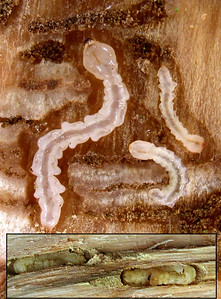
As of this writing, emerald ash borer has been detected in Oregon in the Forest Grove area. Trees at the site where it was first discovered this summer were immediately cut and chipped, but based on experience from the east, it is likely that the infestation is not isolated – and indeed, recent surveys have discovered more affected trees in the area. In Michigan, there were early efforts to eradicate the pest: expensive operations to harvest and chip trees in one city were barely underway before a new infestation was reported in the next county over. So, it is likely that we are on a trajectory to see widespread infestation in the next several years, and potentially the functional loss of ash (at least in the Willamette Valley) within the decade. I would love to be wrong about this. Meantime, here are few questions that might be relevant.


What kinds of trees are susceptible? Ash (Fraxinus spp) are the only emerald ash borer hosts. In Oregon, Oregon ash, Fraxinus latifolia, is the only native species; other species are found in landscape plantings. Among ash, there are some features of resistance–particularly for Asian species that co-evolved with Emerald ash borer; however all Fraxinus species are at risk.


What will Emerald ash borer mean for Oregon, ecologically? Oregon ash typically occurs in mixed hardwood forests, and is particularly abundant and ecologically important in riparian corridors. In the US generally there are 98 arthropods that are dependent on Fraxinus; and to date at least 17 species of arthropods (moths, beetles, mites) specialized on Oregon ash. So the loss of ash in Oregon would extirpate at least a short list of other species. The larger impacts will be at the plant community level. Oregon ash is a major component in riparian areas and wet meadows. If it is lost to Emerald ash borer, these forests will follow one of two (more likely both) paths: reorganization of the existing species (e.g., alder, cottonwood, and big-leaf maple), or colonization by other, perhaps exotic species. Either scenario entails systemic changes in the physical and biological attributes of once ash-rich forests.

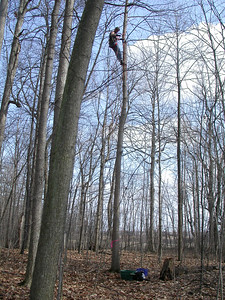
Pesticide treatments are another tool, with two principal applications. In landscape settings where individual trees have high value, pesticide treatment is in many cases more economical than removal. In natural areas, strategic use of treatment has been shown to slow the spread of EAB, giving the state more time to plan for widespread impacts. Of course there are environmental concerns; however the most effective (and expensive) treatment (emamectin benzoate) is a systemic material injected directly into trees, thus minimizing broader release into the environment.
Emerald ash borer and Oregon will be a new ecological experiment that may play out (badly) as it has in the east. But it is unknown how local conditions may change the trajectory. Major questions, and avenues of research: Does Oregon ash have useful genetic resistance to attack? How will emerald ash borer fare in a Mediterranean climate? Are there native natural enemies of related Agrilus that will attack emerald ash borer in Oregon? What role does ash play in Oregon forests, and what are the likely trajectories for a post-emerald ash borer scenario? In the meantime, any evidence of emerald ash borer is of great interest to the Oregon Dept of Agriculture – let them know!
What do I do if I find an emerald ash borer in Oregon? Early detection of new infestations will be critical to the state-wide response; the public can play a major role in surveillance. If you see a potentially infested ash, you can report it to the Oregon Department of Agriculture Invasive Species Hotline online or at 888-268-9219.
Some additional sources of information on Emerald ash borer and its impacts and control:
- Emerald Ash Borer in Oregon, Oregon Department of Agriculture
- Emerald Ash Borer Information Network
- Guidelines to slow the growth and spread of Emerald Ash Borer, Minnesota Department of Agriculture
— David Cappaert is an entomologist with IAE who recently moved to Oregon from the eastern US.

Restoration
Research
Education
Contact
Main Office:
4950 SW Hout Street
Corvallis, OR 97333-9598
541-753-3099
info@appliedeco.org
Southwest Office:
1202 Parkway Dr. Suite B
Santa Fe, NM 87507
(505) 490-4910
swprogram@appliedeco.org


© 2026 Institute for Applied Ecology | Privacy Policy