Enter Search Below

July 2022
Taking a look around, it appears we have landed on the moon. But a glimpse of the Guadalupe Mountains to the west confirms that we are indeed still in New Mexico. We walk with care across the landscape, making sure we don’t leave footprints behind us. After winding our way around spiny shrubs and scattered karst features, circumventing a few smaller draws, and slowly creeping along shallow diagonals cross-slope in and out of some bigger draws, we arrive at our destination: gypsum wild buckwheat (Eriogonum gypsophilum).
Gypsum wild buckwheat is a long-lived perennial wildflower that is endemic to gypsum soils of southeastern New Mexico. The habitat requirements of this species are so specific that there are only four known populations in the world – all of which are found in Eddy County, New Mexico. Gypsum wild buckwheat is currently listed as threatened by the US Fish and Wildlife Service, with one population protected under designated critical habitat. It is also arguably one of the most charismatic plants ever.
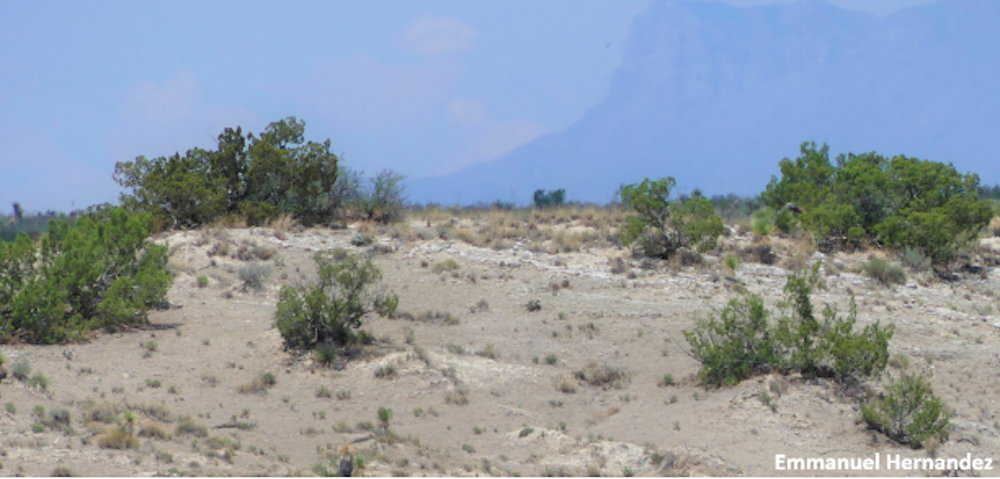
Gypsum is highly erodible, creating karst features that are all over the Carlsbad area. You can think of it as a landscape built like Swiss cheese – there are little holes, caves, and hollow ground beneath your feet everywhere you walk. While we don’t see much of it around here, the rain (when it comes) can really do a number on this place. Channels where water courses down and into the main draw weave their way through the landscape like a spider web of veins. Water has clearly left its mark and continues to shape this landscape. In the areas that gypsum wild buckwheat populates, bio-crust is essential for preventing erosion – not just from water, but also from the powerful winds that come each spring. These thick, dark colored and variously structured living crusts carpet the soil surface and stabilize it wherever plants have not established themselves. It can take decades or even centuries to build up bio-crust this robust, which is why we walk with such care across the landscape; knowing that without them, this whole area would be a powdery cloud that would have washed away many lifetimes ago.
IAE supports monitoring of this species through a contracted position in New Mexico’s Bureau of Land Management Carlsbad Field Office.
Main Office:
4950 SW Hout Street
Corvallis, OR 97333-9598
541-753-3099
info@appliedeco.org
Southwest Office:
1202 Parkway Dr. Suite B
Santa Fe, NM 87507
(505) 490-4910
swprogram@appliedeco.org
© 2026 Institute for Applied Ecology | Privacy Policy