Beautiful Blooms and Bothersome Blossoms: The Dichotomy of Seeing Spring Growth
March 2021
Spring plants are starting to grow, which usually prompts me to message photos to my mom bragging about being able to see daffodils (Narcissus sp.) in bloom before hers have even emerged from the cold soil. In recent years, however, the spring growth has created feelings of a dichotomous nature – spring brings growth of the plants we want…and those we don’t. Small seedlings pop up starting their months-long goal of eventual creation of the next generation of seeds while I start my 8-month botany exploration game of “Who am I looking at?” – an activity to which I am sure many of you readers can relate. On the other hand, working to restore native grassland habitats for rare and endangered plants and butterflies requires a strong connection with the weedy species and an understanding of their seasonal timing and phenology. This dichotomous nature of looking excitedly for the magic of the landscape flourishing with things we planted last fall is mixed with the dread of seeing how many plants are on the list to be killed.
A walk through one of our restoration sites this time of year is filled with many sights. I look to the left and note something uplifting and exciting, like a large patch of streambank lupine (Lupinus rivularis). But then I look right and note the need for a return trip with a shovel or herbicide backpack, “darn you Canada thistle!” Seeing the blooms of all of the plants that are desired elicits excitement, while the blossoms of undesired weeds elicit a dread of the future weed seedlings they will bring.
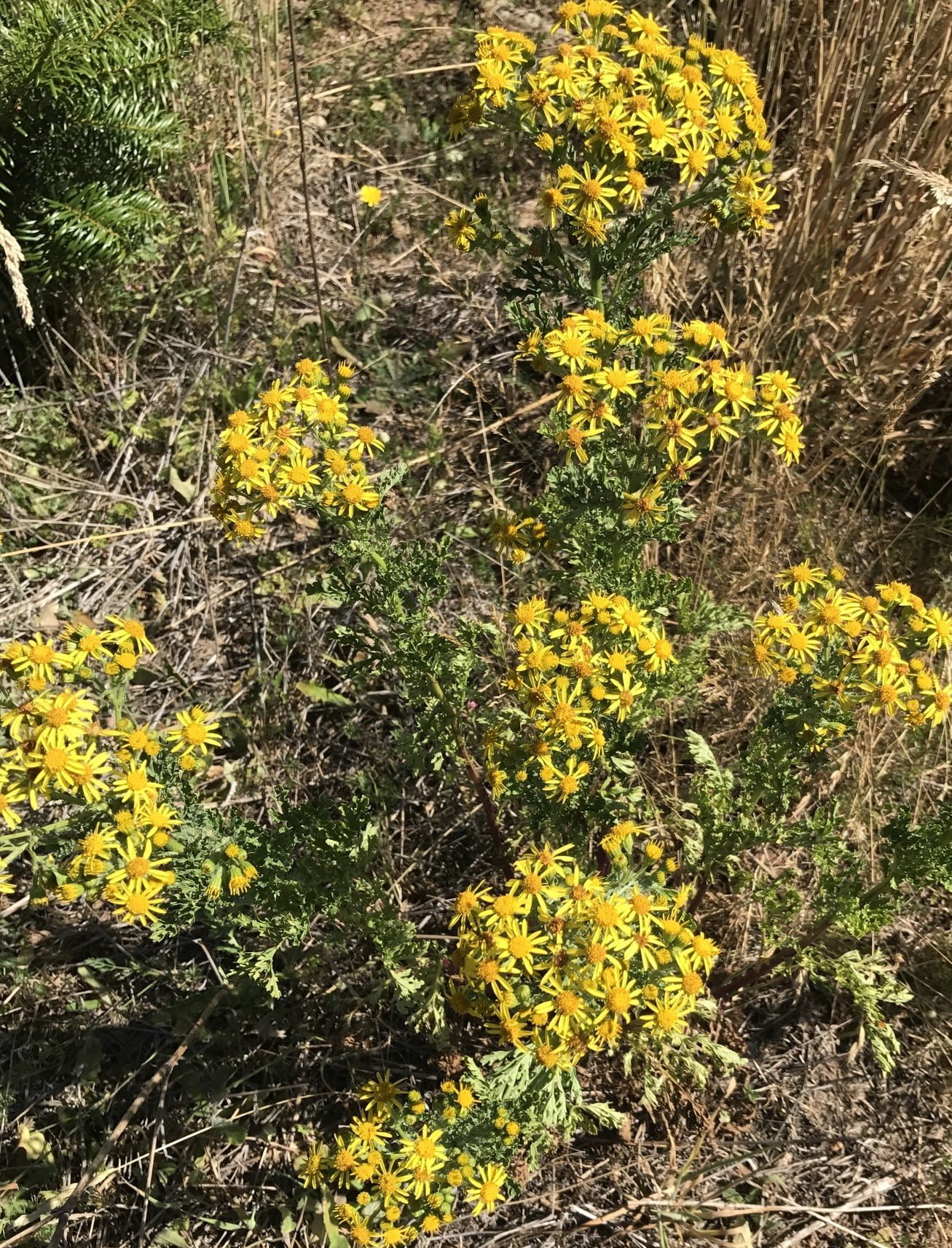
While young tansy ragwort (Jacobaea vulgaris) is fairly conspicuous with the ruffled, leafy, basal rosettes and the wonderful dark purple stems do add a little unique color to the landscape, the hazard it presents is surprising. One tansy ragwort plant can produce 100,000 to 250,000 seeds which are quite long lasting, sometimes remaining in the soil for over a decade. Wow! That little bit of color sure isn’t worth the impact to our restoration plans; those have to go!

Tansy Ragwort (Jacobaea vulgare), seen here as seedling, basal rosette, and bolted plant in flower.

Left: Small camas (Camassia quamash) seen at Fir Butte, West Eugene Wetlands, a restoration site managed by the Bureau of Land Management. Right: American wild carrot (Daucus pusillus) in flower.
Another favorite native plant is American wild carrot (Daucus pusillus). This short-statured cutie with its bracts below the inflorescence lobed to take on a lace-like appearance can easily be overlooked in meadow habitats, but its hidden charm is well worth the searching.

Left: Meadow knapweed (Centaurea x moncktonii) in flower and bud. Right: Queen Anne’s lace (Daucus carota) in vegetative seedling stage.

Restoration
Research
Education
Contact
Main Office:
4950 SW Hout Street
Corvallis, OR 97333-9598
541-753-3099
info@appliedeco.org
Southwest Office:
1202 Parkway Dr. Suite B
Santa Fe, NM 87507
(505) 490-4910
swprogram@appliedeco.org


© 2026 Institute for Applied Ecology | Privacy Policy